The Spiritual Legacy of the Chishtiya Order
The Chishtiya Sufi Order, renowned for its message of love, humility, and service to humanity, was firmly rooted in the Indian subcontinent through the spiritual efforts of Khwaja Moinuddin Chishti رضي الله عنه. His mission of compassion and guidance was not a solitary endeavor; it was strengthened and expanded through the efforts of his closest disciples and Khulafa, who became the pillars of this sacred path. Among them, three figures stand out as the foremost successors entrusted with carrying forward his spiritual mission: Khwaja Qutbuddin Bakhtiyar Kaki رضي الله عنه, Khwaja Fakhruddin Gardezi رضي الله عنه, and Khwaja Hamiduddin Nagori رضي الله عنه.
These blessed Khulafa not only preserved the essence of their master’s teachings but also gave the Chishtiya Order its firm foundation in India. Each of them embodied unique spiritual qualities and played a decisive role in spreading the fragrance of divine love, ensuring that Khwaja Gharib Nawaz’s legacy would continue to shine for centuries.
Khwaja Qutbuddin Bakhtiyar Kaki رضي الله عنه
Khwaja Qutbuddin Bakhtiyar Kaki رضي الله عنه was one of the earliest and most influential Sufi saints to establish the Chishtiya Order in northern India. Born in Hijra 569 (1173 CE) in Ush, a small town near Baghdad, he was spiritually inclined from a young age and soon became a disciple of the great Khwaja Moinuddin Chishti رضي الله عنه in Ajmer.
His title "Kaki" was earned through a miraculous event: it is said that due to his complete reliance on God and refusal to ask for food or money, Allah would send bread (kak) miraculously into his house. This divine provision symbolized his utter dependence on Allah alone, a hallmark of the Chishtiya path. Khwaja"
Qutbuddin lived in Mehrauli, Delhi, during a time when the city was a growing political center. However, he consciously distanced himself from rulers and remained committed to the inner life, preferring spiritual gatherings (majalis) and periods of isolation over political association."
He was known for his deep humility, silent endurance, and intense spiritual practices. Despite attracting many followers, he never sought fame. In fact, it was during a gathering of sama‘ (spiritual music) that he entered a state of intense wajd (ecstasy) while hearing the verse:
"Those who are slain in love of God, their bodies lie scattered in the dust."
Overcome with divine longing, he passed away in this state in Hijra 633 (1235 CE), returning to his Creator in a moment of rapture."
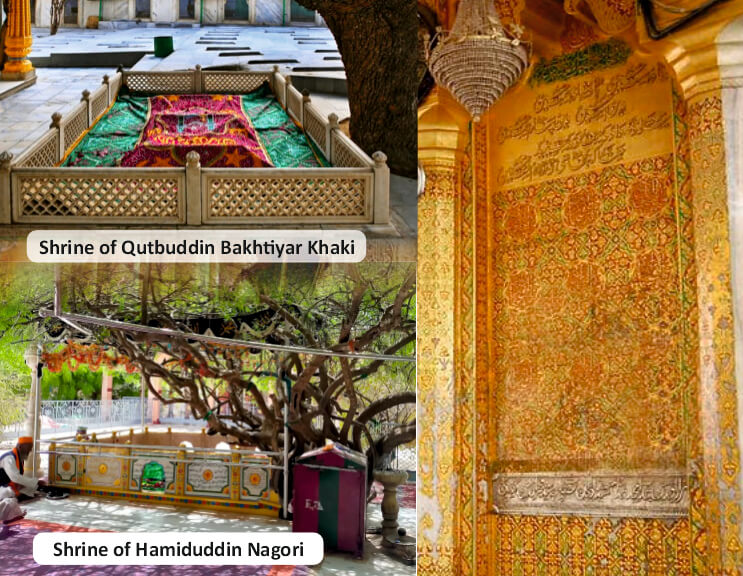
His shrine in Mehrauli remains a spiritual sanctuary, visited by thousands who come seeking peace and blessings. Qutbuddin Kaki's teachings emphasized poverty (faqr), remembrance of God (zikr), and unwavering trust in divine will. He laid the foundation for a uniquely Indian expression of Sufism—one grounded in compassion, humility, and silent service.
Hazrat Hamiduddin Nagori رضي الله عنه
Sultan al-Tariqeen, Hazrat Hamiduddin Nagori Chishti رضي الله عنه, was one of the principal Khulafa of Khwaja Moinuddin Chishti رضي الله عنه and played a significant role in establishing the Chishtiya Order in Rajasthan. His shrine is in Nagaur, which remains a place of spiritual inspiration for seekers to this day.
Born in 589 AH (1113 CE), his birth name was Muhammad, while Hamiduddin and Nagori became his well-known epithets. After receiving his early Islamic education, he came under the guidance of Khwaja Gharib Nawaz رضي الله عنه in Ajmer. With deep devotion and service, he attained khilafat from his master and was instructed to settle in Nagaur for da‘wah and spiritual guidance.
Hazrat Hamiduddin رضي الله عنه was widely respected for his compassion and simplicity. Historical accounts note that he practiced a life of strict discipline and remarkable kindness, embodying the Chishtiya values of humility, service, and love for all of creation.
The blessed resting place of Hazrat Hamiduddin Nagori رضي الله عنه is in Nagaur, Rajasthan. The shrine is marked by the famous Buland Darwaza, built in 730 AH (1339 CE) during the reign of Sultan Muhammad bin Tughlaq. His annual Urs, held from 28 Rabi‘ al-Thani to 4 Jumada al-Awwal, continues to draw thousands of devotees, keeping alive the memory of his piety and spiritual service.
Khwaja Fakhruddin Gardezi رضي الله عنه
Among the most trusted and devoted companions of Khwaja Moinuddin Chishti رضي الله عنه was Hazrat Khwaja Fakhruddin Gardezi رضي الله عنه, whose life was inseparably linked with his master. More than a disciple, he was like a spiritual brother, accompanying Khwaja Gharib Nawaz رضي الله عنه through journeys, struggles, and the mission of spreading Islam in the Indian subcontinent.
His loyalty, humility, and deep devotion made him one of the foremost Khulafa of the Chishtiya Order. Together, they arrived in Ajmer, where Fakhruddin Gardezi رضي الله عنه remained steadfastly by his side, supporting and strengthening the mission of love and service that would define the Chishtiya path for centuries to come.
The full details of his blessed life, his teachings, and his contributions to the silsila are preserved in a dedicated section of this website for seekers who wish to learn more about this noble personality.
The Ongoing Legacy of the Chishtiya Order
In the generations that followed, the mantle of this sacred tradition was upheld by eminent figures such as Zinda Shah Wali Hazrat khwaja Syed Khairathul hasan Chishti رضي الله عنه, Hazrat Khwaja Pir Hafiz Syed Hayathul Hasan Chishti رضي الله عنه, Hazrath Khwaja Faridul Mashaikh Pir Syed Faridul Hassan Chishti رضي الله عنه, and Hazrat Maulana Pir Syed Hammad ul Hasan Chishti, among others. Each of these noble personalities embodied the core values of the Chishtiya Order, nurturing its essence within their communities and continuing the work of their blessed predecessors with deep sincerity and guidance.
Detailed biographical accounts and teachings of these respected successors are available in a dedicated section of this website, offering a deeper understanding of their contributions to the Chishti silsila and their lasting spiritual impact.
Core Message of the Chishtiya Order
- 1. Love for all, hatred for none
- 2. Serving humanity as the highest form of devotion to God
- 3. Spiritual practice grounded in humility, simplicity, and remembrance of God (zikr)
- 4. Avoidance of wealth, power, and material entanglements