Migration to Nishapur
Due to the prevailing unsafe environment, Khwaja Garib Nawaz رضي الله عنه father, Khwaja Giyasuddin رضي الله عنه made the decision to migrate with his family to Nishapur, the capital city. Nishapur was renowned for its Nizamiyyah University and its precious library, which housed a wealth of original Islamic literature. Additionally, the city boasted lush gardens, canals, and flourishing agricultural fields. In one of the suburbs, known as Rewand, his father purchased a grape orchard with a windmill, seeking a peaceful life in the fertile lands.
However, Nishapur itself was not spared from social evils and unrest. Sultan Sanjar, engaged in prolonged battles with the Tartars at the border, was absent from the capital for an extended period. This resulted in the disintegration of his administrative machinery, and internal factions such as the Qarmiti and Batini sect's Fidayees emerged from hiding, engaging in looting and violence, turning the city into a scene of massacre.
These incidents deeply affected Khwaja Garib Nawaz رضي الله عنه stirring profound contemplation within him. However, he found no definite conclusion amidst these distressing events. With the defeat of Sultan Sanjar, the enemy gained free reign, causing the destruction of once-flourishing cities of Islamic culture, reducing them to rubble and ruin.
One can surmise that through these series of events and tragedies, Allah Almighty intended to prepare and showcase Khwaja Garib Nawaz رضي الله عنه for a noble and divine mission of reform and peace for all of humanity. He was destined for an extraordinary path of spreading love, harmony, peace, and exemplifying the true essence of Islamic teachings.
Light of Wisdom
At the tender age of sixteen, Khwaja Garib Nawaz رضي الله عنه suffered the loss of both his parents. Inheriting an orchard and a windmill as his means of livelihood, even at a young age, Khwaja Garib Nawaz رضي الله عنه displayed remarkable compassion and selflessness, embodying the noble traits of character unique to the household of Prophet Muhammad ﷺ to which he belonged.
One day, while tending to his orchard, he noticed a pious Dervish (Saint) named Hazrat Ibrahim Qandoozi رضي الله عنه who had taken a seat under the shade of a tree. Khwaja Garib Nawaz رضي الله عنه approached the Dervish and offered him a fresh bunch of grapes and fruits to eat. Delighted by this gesture, the visitor then took something out of his bag, chewed it himself, and offered it to the young Khwaja Garib Nawaz رضياللهعنه. Without hesitation or question, Khwaja Garib Nawaz رضي الله عنه consumed it, and in that very moment, he felt the illumination of wisdom and knowledge.
Following this profound spiritual incident, he divested himself of all his worldly possessions, including the orchard and windmill, and distributed the proceeds among the poor. Severing all ties with worldly pleasures and comforts, he embarked on a spiritual journey that led him to Samarkand and Bukhara, renowned centers of religious education and knowledge. It was there that he became a Hafiz (having memorized the Quran) and distinguished himself as an Aalim, possessing comprehensive understanding of various Islamic subjects and ideologies.
Although he dedicated himself to prayers, meditation, fasting, and the remembrance of Allah Almighty, he felt that something was still missing in his quest to approach Allah Almighty. In his own words, he proclaimed, "Success is not possible without a Peer (Guide)."
Spiritual Mentor - Khwaja Usman Harwani
Feeling the need for a spiritual master, Khwaja Garib Nawaz رضي الله عنه embarked on a journey in search of such a guide. He traveled extensively, covering vast distances, with the sole purpose of finding his true mentor. Eventually, he arrived in a town called Harwan, where one of the greatest Sufi Dervishes of that time, Hazrat Khwaja Usman Harwani رضي الله عنه resided. This esteemed saint had gained significant popularity and attracted numerous individuals seeking spiritual enlightenment, as well as religious and moral guidance.
Khwaja Garib Nawaz رضي الله عنه approached Hazrat Khwaja Usman Harwani رضي الله عنه with utmost reverence and humility. He kissed the ground as a sign of deep respect and earnestly requested, "May I humbly ask to be accepted as one of your devoted disciples (Mureeds)." Hazrat Khwaja Usman Harwani رضي الله عنه through his intuitive perception, instantly recognized that this seeker was the most deserving and suitable candidate to join the circle of his spiritual lineage. Without any hesitation, he graciously granted Khwaja Garib Nawaz's request, initiating him as a Mureed in his spiritual chain.
Spiritual journey with Peer-o Murshid
In the words of Khwaja Garib Nawaz رضي الله عنه himself, he recounted the events of his initiation by Hazrat Khwaja Usman Harwani رضي الله عنه "I had the honor of appearing before Hazrat Khwaja Usman Harwani رضي الله عنه along with other esteemed luminaries. I humbly bowed my head in solemn reverence. Hazrat Usman Harwani رضي الله عنه instructed me to offer two rakat of prayer, which I did. He then directed me to sit facing the Kaaba (Mecca) and recite Durud Sharif (praise and blessings for the Holy Prophet ﷺ and his family) 21 times, Subhan Allah (glory be to Allah) 60 times, and I complied. After that, he took my hand in his own hand and gazed toward the heavens, saying, 'Let me present you to Allah Almighty.' He then cut my hair with a pair of scissors and placed a special Tarki Cap on my head. He asked me to recite Surah Ikhlas (a chapter from the Quran) one thousand times, and I completed the recitation. He then said, 'Among our followers, there is only one day and one night of probation, so go and fulfill it today.' Accordingly, I spent one day and one night in prayer and presented myself before him the next morning. He asked me to sit down and repeat Surah Ikhlas one thousand times, and I did so. Then he asked me to look toward the heavens. When I raised my eyes, he inquired, 'How far do you see?' I replied, 'Up to Arsh-E-Moalla (the heavenly throne).' He asked me to 'look below,' and I replied, 'Up to Tahtu-Sara (the abyss).' He then asked me to sit and repeat 'Surah Ikhlas' one thousand times again, and I complied. He then asked me to 'look toward heaven' once more, and when I did, he asked, 'How far do you see now?' I answered, 'Up to Hijaab-E-Azmat' He then instructed me to 'close my eyes,' and after a moment, he asked me to 'open my eyes,' and I did so. Then he showed me his two fingers and inquired, 'What do you see through them?' I replied, '18,000 Aalam (worlds).' When he heard this, he said, 'Now your work is over.' He then looked toward a nearby brick and asked me to pick it up. To my surprise, I found some gold coins (dinaars) under it. He instructed me to distribute these coins among the poor and needy, which I faithfully did. Afterward, I was instructed to remain with him until the prescribed period."
Sacred Travels of Khwaja Gharib Nawaz
Hazrat Khwaja Gharib Nawaz رضي الله عنه devoted twenty years in the blessed company of his Pir-o-Murshid, Hazrat Khwaja Usman Harooni رضي الله عنه. During this period, he served with utmost sincerity and completed all stages of Ma’rifat (spiritual knowledge) and Haqeeqat (ultimate truth). Before parting, his Murshid placed sacred relics in his trust and gave him heartfelt advice: “O Moin, never depend on anyone, avoid worldly attachments, and never seek charity. Always remain under the protection of Allah.”
After this, Khwaja Gharib Nawaz رضي الله عنه embarked on long journeys in search of divine wisdom, traveling through Khirqan, Astarabad, Isfahan, Hamadan, Tabrez, and Baghdad. At every stage he met great saints and scholars such as Shaikh Abul Hasan Khirqani, Shaikh Nasiruddin (descendant of Bayazid Bastami), Shaikh Mahmood Isfahani, Shaikh Yusuf Hamadani, and Shaikh Abu Saeed Tabrezi. Each meeting deepened his spiritual light and broadened his understanding.
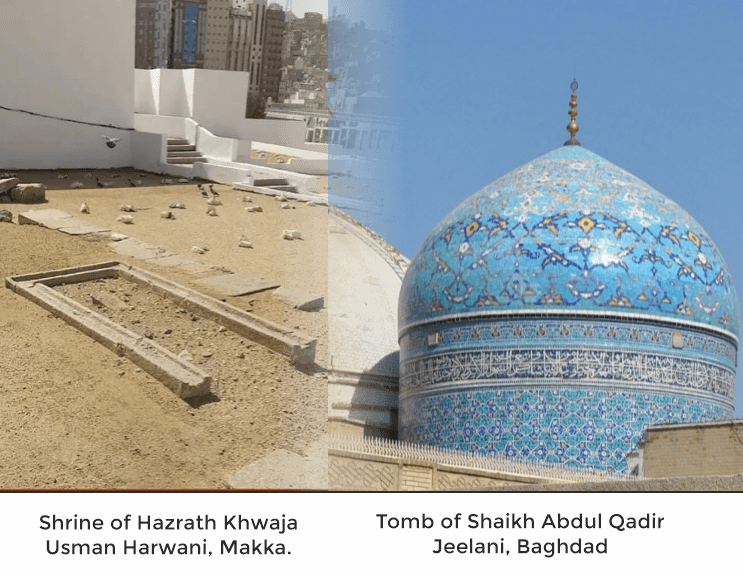
It was in Isfahan that Hazrat Khwaja Bakhtiyar Kaki رضي الله عنه recognized the divine radiance on Khwaja Gharib Nawaz’s face and performed Bayt at his hands, becoming one of his greatest disciples. Later, in Baghdad, Khwaja Gharib Nawaz enriched his soul with blessings at the sacred graves of Syed Abdul Qadir Jilani رضي الله عنه and other revered saints.
In 583 Hijri, Khwaja Gharib Nawaz reached Makkah, where he performed Hajj and devoted himself to prayer and worship. There he heard a divine voice proclaim: “O Moinuddin, I am pleased with you. Ask what you desire.” With utmost humility he prayed for the forgiveness of all his followers, and Allah granted his request.
From Makkah he proceeded to Madinah Munawwara, where he offered salutations at the sacred Rauza of Prophet Muhammad ﷺ. It was there that he received the life-changing command: “O Moinuddin! You are chosen to strengthen our religion. Go to Hind, settle in Ajmer, and spread Islam.” That very night, in a dream, he was shown a clear map of Hind with Ajmer marked as his destined station.
Overwhelmed with spiritual ecstasy yet firmly resolved, Khwaja Gharib Nawaz رضي الله عنه set out on his journey towards Hind. His mission was now clear—to establish peace, love, and the message of Islam in India, where the city of Ajmer awaited him as the center of his eternal service to humanity.